


Top 10 Water Irrigation Hose Types Which One Is Best?
Choosing a Water Irrigation Hose is not as simple as picking the longest or cheapest option. A vegetable bed, greenhouse, orchard, and construction site demand different water delivery solutions. Each setting changes the pressure, flow rate, flexibility, and durability required.
Dr. Daniel Hillel, a respected soil and water scientist, wrote, “The ultimate goal of irrigation is not to supply water, but to supply water in a way that optimizes crop production.” That principle guides this comparison. A hose should distribute water evenly, protect plant roots from sudden pressure changes, and reduce unnecessary waste. Practical details matter. A lightweight soaker hose may gently wet tomato rows, while a reinforced PVC hose can handle higher pressure near a pump. A food-safe hose may be essential for edible crops.
No hose wins everywhere.
This guide examines ten common Water Irrigation Hose types, including soaker, drip, lay-flat, reinforced rubber, PVC, and porous hoses. It compares their materials, pressure tolerance, fittings, maintenance needs, and typical service life. Field experience shows that small design choices matter. A kinked hose can stop water flow beside a dry plant. Poor connectors can leak beneath hot sunlight. Still, the “best” choice depends on soil, distance, water pressure, climate, and budget. The ranking may not fit every farm or garden. That limitation deserves attention. Reliable irrigation comes from matching the hose to the job, not trusting a universal winner.
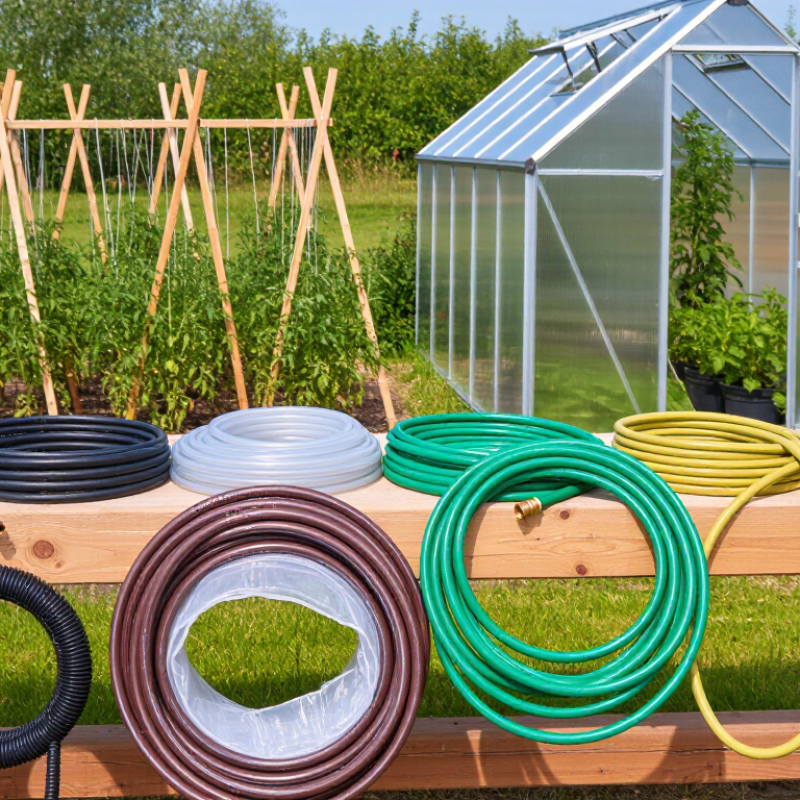
What Is a Water Irrigation Hose and How Does It Work?
A water irrigation hose is a flexible tube that carries water from a pump, tap, or storage tank to crops and landscapes. It works through pressure, flow rate, and controlled outlets. A plain hose releases water at its open end, while drip, soaker, sprinkler, and porous hoses distribute it differently. Small emitters apply water near plant roots. Sprinkler hoses spread droplets across a wider area.
Not complicated. But selection matters. The FAO AQUASTAT database reports that agriculture uses about 70% of global freshwater withdrawals. Poor hose design can increase runoff, evaporation, and soil erosion. The U.S. Environmental Protection Agency estimates that inefficient landscape irrigation can waste up to 50% of outdoor water through evaporation, wind, and runoff. A low-pressure drip hose may suit vegetable beds, while a reinforced sprinkler hose fits larger, flatter areas.
In field use, measure the hose length, operating pressure, and required flow before buying. A hose that is too narrow may reduce pressure at distant plants. One that is too large can become heavy and difficult to move. Filters also matter, especially with drip systems, because sediment can block emitters. I have found that “water-saving” claims need careful checking; soil type, slope, weather, and maintenance often change the result. The best hose is not universal. It matches the crop, ground, pressure, and daily routine.
Top 10 Water Irrigation Hose Types Which One Is Best? - What Is a Water Irrigation Hose and How Does It Work?
A water irrigation hose is a flexible tube that carries water from a supply point to plants, beds, containers, or other landscape areas. Water flow is created by supply pressure, while hose diameter, length, fittings, and the selected delivery method affect the final flow rate.
| Rank | Hose Type | How It Works | Typical Material | Common Diameter | Typical Working Pressure* | Best Application | Main Advantages | Main Limitations | Overall Suitability |
|---|---|---|---|---|---|---|---|---|---|
| 1 | Drip Irrigation Tubing | Delivers water slowly through built-in emitters or connected drip emitters directly to the root zone. | Polyethylene | 13 mm or 16 mm | Usually about 1–3 bar (15–45 psi), depending on the tubing and emitters | Vegetable gardens, planting beds, shrubs, and greenhouse rows | Very water-efficient; reduces evaporation, runoff, and wet foliage; precise application | Can clog without filtration; requires careful layout and pressure regulation | Best overall for efficient plant watering |
| 2 | Soaker Hose | Porous walls allow water to seep gradually along the hose length when the line is pressurized. | Porous recycled rubber or porous polyethylene | 13 mm or 16 mm | Usually about 0.7–2 bar (10–30 psi) | Flower beds, hedges, rows of vegetables, and established landscapes | Simple to install; waters a continuous strip; less foliage wetting than sprinklers | Coverage can be uneven on slopes or long runs; may clog or kink | Best for simple garden beds |
| 3 | Flat Lay Hose | Unrolls flat for storage and expands when water flows through the flexible tube. | PVC, thermoplastic elastomer, or reinforced fabric composites | 25 mm to 50 mm | Often about 2–6 bar (30–90 psi), product dependent | Temporary irrigation, greenhouse work, and seasonal water transfer | Compact storage; lightweight; easy to move between locations | More vulnerable to abrasion, twisting, and puncture than rigid wall hoses | Best for portable seasonal use |
| 4 | Garden Hose with Sprinkler Attachment | Carries pressurized water to a sprinkler, wand, or spray head that distributes water over a wider area. | Rubber, PVC, or reinforced thermoplastic | 13 mm, 16 mm, or 19 mm | Commonly about 2–5.5 bar (30–80 psi) | Lawns, small beds, containers, and hand watering | Versatile; compatible with many attachments; easy to reposition | Higher evaporation and runoff risk; distribution depends on nozzle and water pressure | Best for flexible general-purpose watering |
| 5 | Micro-Irrigation Distribution Tubing | Moves water from a mainline to individual drip emitters, micro-sprayers, or adjustable bubblers. | Flexible polyethylene | 4 mm, 6 mm, or 13 mm | Usually about 1–3 bar (15–45 psi) | Container plants, raised beds, hanging baskets, and small planting zones | Easy to branch and customize; supports targeted watering in compact areas | Small tubing has limited flow capacity and can be damaged by sunlight or garden tools | Best for modular small-area systems |
| 6 | Layflat Discharge Hose | Provides a large water passage for transferring water from pumps or tanks; it flattens when empty. | Reinforced PVC or coated synthetic fabric | 25 mm to 100 mm | Varies widely; commonly about 2–10 bar (30–145 psi) | Large gardens, drainage, pump discharge, and temporary irrigation lines | High flow capacity; lightweight compared with rigid pipe; stores compactly | Not ideal for precise plant-by-plant watering; requires suitable couplings and pump sizing | Best for high-volume temporary transfer |
| 7 | Heavy-Duty Rubber Hose | Uses a thick, flexible rubber wall to transport pressurized water for long periods or demanding use. | EPDM or other water-service rubber compounds | 13 mm, 16 mm, or 19 mm | Often about 5–10 bar (70–145 psi), depending on construction | Commercial gardens, nurseries, and frequent hand watering | Durable; good kink resistance; performs well under frequent handling and temperature changes | Heavier and usually more expensive; should be selected for potable-water compatibility when required | Best for demanding general use |
| 8 | Expandable Hose | Shortens when depressurized and expands when filled, usually around a flexible inner tube. | Latex or rubber inner tube with woven textile cover | Commonly 13 mm or 16 mm | Often about 3–5.5 bar (45–80 psi), product dependent | Light-duty residential watering where storage space is limited | Lightweight; compact when empty; easy to carry | Textile covers and inner tubes can wear, split, or leak if dragged or left in harsh conditions | Best where low weight and compact storage matter |
| 9 | PVC Reinforced Irrigation Hose | Uses a reinforced wall to carry water through fixed or semi-permanent irrigation layouts. | Flexible PVC with textile or spiral reinforcement | 13 mm to 50 mm | Commonly about 3–8 bar (45–115 psi) | Nurseries, greenhouse benches, transfer lines, and general irrigation plumbing | Good chemical resistance; available in many sizes; relatively easy to clean and connect | Can become stiff in cold weather; quality and pressure rating vary significantly | Best for versatile fixed or semi-fixed systems |
| 10 | Perforated Sprinkler Hose | Small holes spray or sprinkle water upward or sideways along the hose when pressurized. | Perforated PVC or rubber | 13 mm or 16 mm | Usually about 1–3 bar (15–45 psi) | Narrow lawns, borders, seed beds, and short rectangular areas | Simple above-ground installation; provides broad coverage without separate sprinkler heads | Pattern changes with pressure; wind can affect coverage; less precise than drip irrigation | Best for short, narrow coverage areas |
*Pressure ranges are general operating ranges rather than universal specifications. Always follow the hose, fitting, emitter, and pump manufacturer’s rating. For most water-saving plant irrigation, drip tubing is usually the best choice; for a simple continuous strip of watering, a soaker hose is often the most practical option.

