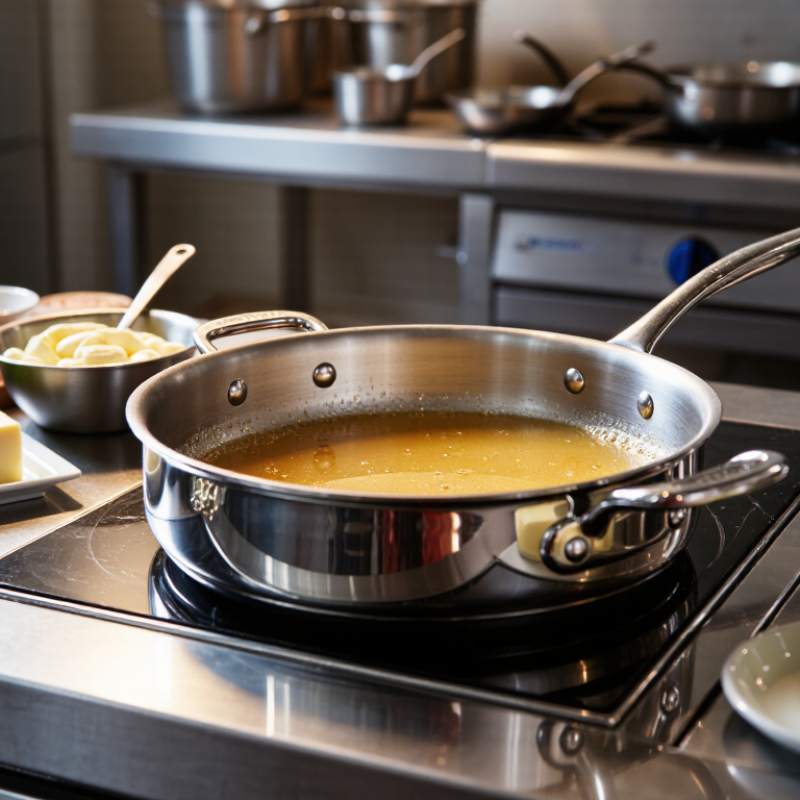
How to Choose the Best Saucier Pan for Your Business?

Choosing the right Saucier Pan can influence speed, consistency, and profit in a professional kitchen. It affects sauce texture, cooking control, cleaning time, and staff comfort. A pan that performs well during a quiet test may struggle during a busy dinner service.

Chefs and purchasing managers should examine capacity, material, heat distribution, handle design, and cleaning requirements. Stainless steel offers durability and clear color visibility. Aluminum heats quickly but may require greater care. Multi-layer construction can improve control, although it often increases the purchase price. Consider the recipes your team prepares most often. A narrow pan may reduce evaporation, while a wider base can support faster reduction. Small details matter.

Test before committing.

I have learned that specifications alone do not reveal everything. A pan may feel balanced in a showroom but become tiring after repeated lifting. Its rounded sides may support whisking, yet make storage less convenient. These trade-offs deserve honest evaluation. Ask suppliers about thickness, compatibility with induction equipment, warranty coverage, and replacement availability. Reliable documentation also helps protect your investment.

The best choice depends on workflow, not fashion. Compare several models under realistic conditions. Prepare a sauce, monitor heat response, wash the pan, and inspect its finish afterward. Record staff feedback, even when it challenges your initial preference. That step is easy to skip. It can prevent an expensive mistake. This guide explains how to assess each factor and select a Saucier Pan that supports dependable results across your business.

How to Choose the Best Saucier Pan for Your Business?

Define the Saucier Pan’s Role in Commercial Kitchen Operations

A saucier pan is not just a smaller saucepan. Its rounded sides help a whisk move smoothly through reductions, custards, and pan sauces, with fewer corners where ingredients can catch. In a commercial kitchen, that shape matters during fast service: cooks can stir continuously, pour from the curved rim, and move the pan between burner and prep station. ENERGY STAR notes that restaurants use about five to seven times more energy per square foot than other commercial buildings. That makes efficient burner use and sensible pan sizing operational concerns, not minor details. A pan that is too large can waste heat; one that is too small may force extra batches.

Tips: Match capacity to your busiest regular batch, not your largest occasional order. Check that the base sits flat on your burners, the handle stays clear of neighboring stations, and the rim pours without drips. Test it with a real sauce. A pan can look right on a specification sheet and still feel awkward when one cook is whisking under pressure. That is worth admitting—and checking before purchase.

Define the pan’s role before comparing materials or price. If it handles delicate emulsions, prioritize responsive heat control and a comfortable grip. For repeated reductions, consider durability, weight, and how easily staff can clean the curved interior. Ask cooks to test the pan during a normal prep shift; their feedback may be imperfect, but it often reveals the practical problems a purchasing checklist misses.

How to Choose the Best Saucier Pan for Your Business?

Define the Saucier Pan’s Role in Commercial Kitchen Operations

Pan capacity should match the kitchen task and batch size. Smaller saucier pans are suitable for reductions, emulsions, and finishing sauces, while larger capacities support batch preparation during service. Choose a pan that provides enough working volume without making stirring, temperature control, or handling difficult.

Match Pan Size and Shape to Your Menu and Batch Requirements

How to Choose the Best Saucier Pan for Your Business?

Match Pan Size and Shape to Your Menu and Batch Requirements

A saucier pan should fit the food, not just the stovetop. A 20–24 cm pan suits beurre blanc, reductions, and two-portion pasta sauces. Its rounded sides help a whisk reach the edges without leaving flour or butter behind. For six to ten servings, choose a 28–32 cm pan with higher walls. This reduces splashing during busy service.

Batch size affects consistency. A pan that is too wide can evaporate sauce before the center heats properly. A narrow pan may create uneven heating and force longer cooking times. The USDA Economic Research Service reported that food-away-from-home spending represented 58.5% of total U.S. food expenditures in 2023. Customers are eating out frequently, so repeatable portions matter. Measure your busiest recipe in liters, not guesses.

Shape also follows the menu. Choose a broad base for risotto, curry, or shallow braising. Select a deeper bowl for cream sauces and liquid-heavy preparations. The National Restaurant Association’s 2024 industry report projected U.S. restaurant sales above one trillion dollars, while operators continued facing pressure from food and labor costs. That makes usable capacity important. Still, bigger is not always better. I once selected a large pan for flexibility, but small batches reduced too quickly around its edges. Test the pan with your real recipe, burner, and serving schedule. A little waste reveals a lot.

Evaluate Materials, Heat Performance, and Sauce Control

How to Choose the Best Saucier Pan for Your Business?
Evaluate Materials, Heat Performance, and Sauce Control

Material choice affects daily speed, consistency, and cleaning time. A three-ply stainless steel pan with an aluminum core offers balanced heat distribution. It responds faster than thick, single-layer steel. Copper heats even more quickly, but it usually demands careful handling and maintenance. For busy kitchens, durability may matter more than maximum responsiveness. Check whether the pan works with your cooktops, including induction.

Heat performance becomes critical when reducing cream, stock, or wine. A pan that heats unevenly can scorch the edges while the center stays thin. Rounded sides help heat travel around the sauce and make whisking easier. Keep the temperature moderate. High heat often creates unwanted sticking, especially with dairy-based sauces. I have found that a heavier base improves stability, but it can also slow temperature changes. That trade-off deserves honest testing.

Sauce control depends on more than the metal. Choose a wide base, sloped sides, and a comfortable handle with a secure grip. These features support whisking, tossing, and clean pouring during service. A smooth interior also helps chefs spot lumps, separation, or burnt residue quickly. No pan is perfect. I still prefer testing one with a real batch before ordering many. Use the same recipe, burner, and cleaning routine. Small differences become obvious then.

Check Handle Design, Compatibility, and Cleaning Requirements

How to Choose the Best Saucier Pan for Your Business?

A busy kitchen tests a pan’s handle before its finish. Choose a riveted, heat-resistant handle with enough clearance for a gloved hand. A rounded, balanced grip helps staff stir thick sauces without twisting their wrists. Check the pan fully loaded; an empty pan can feel misleading. Handles may still become hot near the stove, so train staff to use dry side towels or suitable mitts.

Compatibility matters during a rushed service. Match the pan’s base to your cooktop, and check its diameter against the burner. For induction, confirm that the base is magnetic and sits flat. A warped pan heats unevenly. Cleaning also deserves a close look: smooth interior curves reduce corners where sauce can cling, while removable or loose handles may create extra crevices. The CDC estimates that 48 million people in the United States get sick from foodborne illnesses each year; this estimate is not specific to restaurant kitchens, but it underscores why dependable cleaning routines matter. Choose a pan that staff can wash and inspect thoroughly. Easy to overlook.

Tips: Ask staff to test the handle with a full pan of water, then check the manufacturer’s cleaning instructions. If the pan requires special care, be honest about whether your team can follow it during a busy shift. That small compromise can be easy to miss.

Compare Costs, Durability, and Supplier Support Before Buying

A saucier pan earns its place through daily use, not a polished product description. Compare the full cost, including replacement lids, handles, and shipping. A lower purchase price can look attractive until thin metal warps on a busy burner. Ask for the pan’s material, base thickness, capacity, and warranty terms in writing. Check those details against your menu and cooking volume.

Durability shows up in small moments. Does the handle stay cool enough during a short sauce reduction? Does the pan sit flat after repeated heating and washing? For a working kitchen, inspect the rim, rivets, and interior finish. These areas take frequent knocks and scrubbing. If possible, request a sample and test it with your usual utensils. One test is not proof of years of service, but it can reveal a loose handle or uneven base. It may not reveal everything.

Supplier support matters when a pan arrives damaged or your team needs a replacement quickly. Ask how long common parts remain available, what the return process requires, and who answers product questions. Get expected delivery times, not just a promise of fast service. Keep the replies with your purchasing records. A dependable supplier should give specific answers without pressuring you to buy. Sometimes the cheapest option still makes sense; sometimes the delay costs more than the pan. That call depends on your kitchen.

How to Choose the Best Saucier Pan for Your Business? — Compare Costs, Durability, and Supplier Support Before Buying

Pan Type Typical Capacity Indicative Unit Cost (USD) Durability and Maintenance Best Suited For Supplier Support to Confirm Buying Consideration
Tri-ply stainless steel 2–3 qt (1.9–2.8 L) $40–$100 Generally long-lasting and resistant to corrosion. Can tolerate metal utensils; food may stick if the pan is not heated and used properly. Busy commercial kitchens needing a versatile pan for sauces, reductions, and sautéing. Ask about construction details, warranty coverage, replacement availability, and bulk-order lead times. A practical all-round option; compare wall thickness, handle attachment, and cooking-surface quality rather than price alone.
Clad stainless steel with a thicker core 2–4 qt (1.9–3.8 L) $70–$160 Durable, with more even heat distribution than basic single-layer stainless steel. Heavier construction may be harder to handle during long shifts. Restaurants preparing delicate sauces or working across a range of burner temperatures. Confirm the number and composition of layers, induction compatibility, warranty terms, and whether spare lids are available. Higher upfront cost may be worthwhile where consistent heat control and frequent use are priorities.
Aluminum with nonstick coating 2–3 qt (1.9–2.8 L) $20–$60 Lightweight and quick to heat, but the coating can wear or scratch. Use nonmetal utensils and follow the supplier’s temperature guidance. Lower-volume kitchens or tasks where easy release and quick cleanup are important. Check coating-care instructions, commercial-use warranty exclusions, replacement availability, and recommended service life. Often has a lower purchase price, but replacement frequency and coating care affect long-term cost.
Hard-anodized aluminum 2–4 qt (1.9–3.8 L) $35–$100 Lightweight, with a hard surface that resists ordinary wear better than untreated aluminum. Compatibility with induction cooktops varies by model. Kitchens seeking responsive heating without the weight of some clad-steel pans. Verify cooktop compatibility, cleaning requirements, warranty coverage, and the availability of matching replacement parts. Check the base construction and surface-care limits before choosing it for high-heat or heavy-duty use.
Heavy-gauge stainless steel 3–5 qt (2.8–4.7 L) $30–$90 Robust and suitable for frequent kitchen use. Heat response may be less even than multi-layer clad construction, depending on the base. Batch preparation and general-purpose kitchen work where a larger capacity is useful. Ask about base construction, handle security, delivery times, warranty process, and availability of lids or replacement pans. Compare empty weight and base design; a large pan can be cumbersome when full.
Copper-core or copper-clad stainless steel 1.5–3 qt (1.4–2.8 L) $100–$250+ Offers responsive heat control in many designs. Exterior finishes may require additional care, and the higher purchase cost raises replacement exposure. Specialty kitchens where precise temperature adjustments are especially valuable. Confirm which layers contact the food, care requirements, warranty coverage, repair options, and stock availability. Consider whether the performance benefits justify the cost for the kitchen’s menu and frequency of use.
Note: Price ranges are indicative planning estimates in U.S. dollars for individual pans, not supplier quotations. Actual prices vary by capacity, construction, region, order quantity, and date. Before purchasing, request written pricing and warranty terms, confirm cooktop compatibility, and compare total cost over the expected service life.

Article Source: